Memes, they are honestly the one thing right now that is holding our society together. I mean, there is literally nothing better than opening twitter after a big sports game, and seeing all the memes about what occurred in the game, or when Dogecoin is up a million percent, and is literally breaking twitter. I am not a maker of memes, but I am by all means a consumer of them. Twitter is currently the meme capital of the world right now, you can literally open up the platform, and there is a good chance that whatever is in the top 10 trending in the world will be flooded with memes. What is so interesting now is that posting memes is expanding from just the traditional form of people posting them. You are now seeing brands constantly posting memes on their platforms, in order to interact with the younger generation. Dogecoin for example, is an internet phenomenon at the moment, as it is a crypto currency that is taking the world by storm. It was essentially made as a joke in honor of the famous shiba dog meme. Well, the people have spoken, and some of the richest men in the world in Mark Cuban, and Elon Musk are now backing this coin. They believe that it has real world value, and it is no longer a joke. Brands that have no business being involved in Doge are getting in on the memes, as companies like Slim Jim, and Budweiser are constantly tweeting about this phenomenon. It is honestly brilliant marketing, as these companies are capitalizing off the massive online community that Doge has garnered. There are literally fan accounts with millions of followers, as this community is growing by the day. What is beautiful about Dogecoin is that memes are connecting people, and everyone is getting in on an experience that can last a lifetime. Who would have thought that a silly crypto currency, would now have a massive fan base, and be the fourth largest in the world by market cap. As comedy/memes grow more, and more offensive, it is beautiful to see such a positive online community like Doge continue to grow by the day.
The story of 8chan is a cautionary tale of what happens when free speech turns into hate speech, that can cause danger in American lives. The HBO max documentary “Q Into the Storm” explores how a message board designed to promote free speech can quickly turn into a dangerous militia. Started by founder Fredrick Brennan, 8 chan was intended to just be a place where people go and vent their frustrations with daily life. This was an uncensored, and unmoderated platform, and drew to people like Fredrick, who felt that they did not fit into society. What made it so popular is that everything was so open, and free, as people who felt disenfranchised by society had a place to go that welcomed them. 8 chan was similar to reddit in a way, as it is built as an online forum, with a “Were all in this together” type of attitude. The issue with 8chan, was that it was too open, and too free, as over time people started to use the platform to push their own dangerous/crazy agenda. 8chan eventually became a place for people who honestly want to see the world burn vent their anger and frustrations. The Watkins family is particularly to blame for this, as they squeezed Fredrick out of 8chan, and the forum became the uncensored home of Q’anon. The forum almost turned into a sick game, as Ron Watkins who in all likelihood is the founder of Q’anon, is literally toying with people’s heads in order to push an agenda. Q’anon is literally like a game of clue, as the user named “Q” (Ron Watkins) will drop hints for his followers to solve, and to piece the puzzle together. The people who are on this site are literally used as pawns, and this causes real world danger. Take Pizzagate for example, as this was a conspiracy theory that Hilary Clinton was running a child sex trafficing ring at a pizza place. Well what happened next? A man stormed the pizza place with a gun. Next was the insurrection at the capitol, as “Q” was pushing conspiracy theories that Donald Trump had won the election. This was an online agenda being pushed by people who are insecure about their own lives, and want to watch the world burn. This documentary is a cautionary tale of what happens when you have unfiltered speech, and shows that we need a moderation system of checks and balances on the internet to keep something like Q”anon from never forming again.
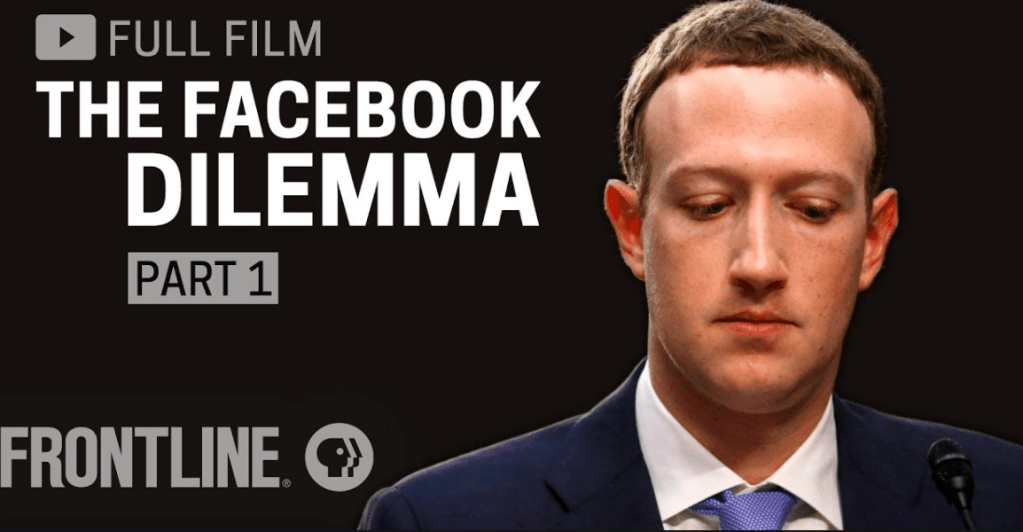
After watching “The Facebook Dilemma” it really opened my eyes as to how Political Campaigns can capitalize off of using the platform for fake news. Facebook is a large, and more complex network then your average social media site, so it is easy for stories to take off on there. Thus, due to the structure of the platform, it is easier for misinformation to spread rapidly. Initially, facebook was honestly fine with this, as all they care about is advertising dollars from clicks, and website traction. Due to this negligence, far right conspiracy theories played a massive role in the outcome of the 2016 election. These crazy stories ranged from Hilary Clinton Having a body double, to her running a child sex trafficing ring in the basement of a pizza shop. This largely benefited the Trump campaign, as they had no direct ties to these stories, but allowed them run rampant by not denying them. This spread of fake information benefitted Trump massively, and is largely to blame for his victory in the 2016 election. A large factor in creating these crazy and far fetched stories is the Russian Government. Russia saw the American Political political landscape as being volatile, and in a fragile state, and seized on their opportunity to pit american citizens against each other. Russia would create fake accounts on facebook, and they would push these wildly false stories about american politicians. The goal of this is to make one side hate the other, and it ultimately is a threat to society. The goal of hackers from countries like Russia is to destroy democracy at all costs, and this film depicts that Facebook was just a pawn in Russia’s game. Ultimately, this film depicts that we as Americans are in a very fragile state right now, and who knows what the future holds in the digital world.
This week, I stumbled upon the Documentary “Social Animals” on Netflix. The film gave us a look inside the social media usage of three young adults, and how social media (for better or for worse) affects their lives. The Film explored the attraction that we as a society have to social media, and what specifically implores us to waste godly amounts of time on these platforms daily. For young adults in particular, it chronicles the alternative realities that social media can create for the next generation.
The film tells the stories of Kaylin, Humza, and Emma, and the relationship they have with social media. Our main characters all derive from largely different backgrounds, and this affects their social media presence. Take Kaylin for example, she has all the tools at her exposal. She is rich, and beautiful, which is honestly the easiest way to grow your social media portfolio. Due to her family’s wealth, she is able to collaborate with other popular creators in leading industries through social media, and even plans to start her own fashion brand. This reminded me a lot of certain people I attended high school with, as I came from a wealthy background. I know tons of kids who were only able to get to where they are right now due to their good looks/ parents money. Some of these people even have millions of followers on Tik Tok which is main boggling to me. The story of Kaylin did not really resonate with me, as I would not consider myself good looking, and I have formed my own career path separate from my parents aspirations.
The next character covered is probably the most ordinary story of them all in terms of upbringing, and social media use. Emma seems like your average american girl, as she has a modest social media following, and goes to a local catholic school. Like most teens who aren’t influencers, Emma uses social media to post artsy pictures of herself, follow the lives of famous people, and talk to her friends. However, Emma falls into a tragic cycle of cyberbullying that many young adolescents have to deal with. The problem with social media is that it is so easy to say things that you would never in a million years say to one’s face. Teens are in a very uncomfortable stage of their lives as puberty is in full force, and I believe that young adults bully each other in order to feel better about themselves. Emma falls into a trap, as the entire school takes to social media to call her vulgar names. This is tragic, as Emma is just your average teenager, and in no way shape or form signed up for this when she created an Instagram account. The story of Emma’s bullying, and eventual suicide attempt is a cautionary tale, and highlights the dangers of social media.
Moving on to the much more positive story of Humza, who is a young photographer in New York City. Humza never felt like he really fit into any of the stereotypical social groups surrounding him. This is why he chooses to take an interest in photography. This is great due to the fact that Humza is surrounded by gangs, and illegal activity, and very easily could have fallen into that world. Instead of seeking the gratification from robbing a convenience store, or getting in a fight, Humza finds that gratification on Instagram. Humza began to gain a very large Instagram following, and is known for taking daredevil style photos on top of bridges in NYC. The beauty of Humza’s story is that he literally has built a career, and social media following out of nothing. Instead of being involved in a gang, or illegal activity, Humza has built such a successful career that college students like me are writing a paper about him. I really could resonate with his story, as despite all the things stacked against him, he has been able to garner an audience he never could have imagined having when he first started taking pictures.
About a year and a half ago, I left my first College due to mental health issues. Like Humza did at times, I felt like I had hit rock bottom, and didn’t feel like I fit into any of the boxes the world has laid out for me. Eventually, I decided that I wanted to create something that I could be proud of, and I did that by creating my own sports brand on social media. To this date, we have eight thousand followers across all platforms, and I couldn’t be happier. That is why I connected to Humza’s story the most, as he is the perfect example of being able to go from nothing, and turn that nothing into something positive.
Lastly, I firmly believe that the statement “we all have edited selves on social media” could not be more factual. What we put on social media is firmly our choice, and we dictate what we want the world to see. I don’t know anybody that will willingly put information on social media that puts them in a negative light. We show the world what we want them to see, plain and simple. That’s honestly why I believe that people have so many mental health problems from social media. For someone who is not as secure/comfortable with themselves who checks social media all day, all you are seeing are these cookie cut images people present you with. It is so easy to become depressed from this, believe me i’ve been there. It is so truly hard to find someone who is remotely like the image they create on social media, and I believe that is a travesty.
When listening to Emily Bell on the “Big Tech” Podcast, it required me to take a step back, and look at the role journalism has in today’s society. Journalism is extremely important to society for multiple reasons. For starters, journalism keeps our politicians in check, and holds them accountable. Without honest, and unbiased Journalism, the people in charge of running our great nation could potentially abuse our countries democratic values. Journalism also functions as a way to inform the public of the problems the world faces, and how we can fix them. It informs the people on many facets of daily life, whether it’s sports, politics, finance, or even pop culture, journalism is designed to function as the main way we as a nation stay informed.
However, to the detriment of our society, the internet has changed the journalism industry for the worse. When the Internet was invented in the early 1990’s, many had believed this would be a positive thing for the news industry. On paper, it’s honestly hard to argue with that assertion. For starters, the internet functions as a way to reach a large audience, so this was viewed as a win-win situation for the industry. All they had to do was put their daily paper on a website, and just like that they could reach citizens all over the world who would not normally have access to their publication. Except, it was not that simple.
First off, the way the newspapers presented their content was not user friendly in the slightest bit. A version of the New York Times for example would literally just be a copy and paste of the newspaper, the same as the one delivered to people’s doorsteps. It is night and day looking back on how Newspapers presented their content in 1993, to how they do now.
To make matters worse, large search engines like Google proceeded to undercut the main source of revenue these Newspapers relied on in advertising dollars. Advertising in Newspapers was, and still is crucial to the success of these organizations. Once the internet, and Google came into the fray, they were able to offer advertisers things that the papers could not. Not only would Google offer these companies cheaper prices to advertise with them, they would also provide these companies with a larger reach to gain traction for their products. This undercut the news Organizations, and as Emily King mentioned, this was the main way that big tech subsidized journalism.
Aside from the financial problems that came with the internet, that was the least of the problems for the industry. The internet essentially gives everyone a platform to say basically anything they want, with largely very few reprecttuions. In theory, anybody could start their own blog, and reach a large audience. This type of access to content that was not at times credible was detrimental to the new media’s own credibility. This led to the rise in fake news, and people not knowing what source of news is reliable/unbiased. The internet is the meeting ground for mis information, and conspiracy theories, as the news media does not have the grip on the american public like they once did.
To be honest, it will be hard for the media to function for the public good like they once did. The mainstream media has already been beat to the punch, as there are alternative sources of media that have been more accessible/more user friendly outlets that dominant today’s media landscape. Take platforms like Brietbart, and Vox, these are platforms that aren’t even close to as reliable/trustworthy as say the Washington Post, or the Philadelphia Inquirer. But yet, they are biased blogs that take away readers from respectable news outlets. Which is why in order for news media to function as a public good, we need big organizations, and companies to pour money into historically respectable, and unbiased newspapers. We need money to be put into these news outlets to combat the spread of fake news, and drown the conspiracy theorists out.
Granted, this proposal is a lot easier said than done, but it may be our only chance for journalistic integrity to survive.
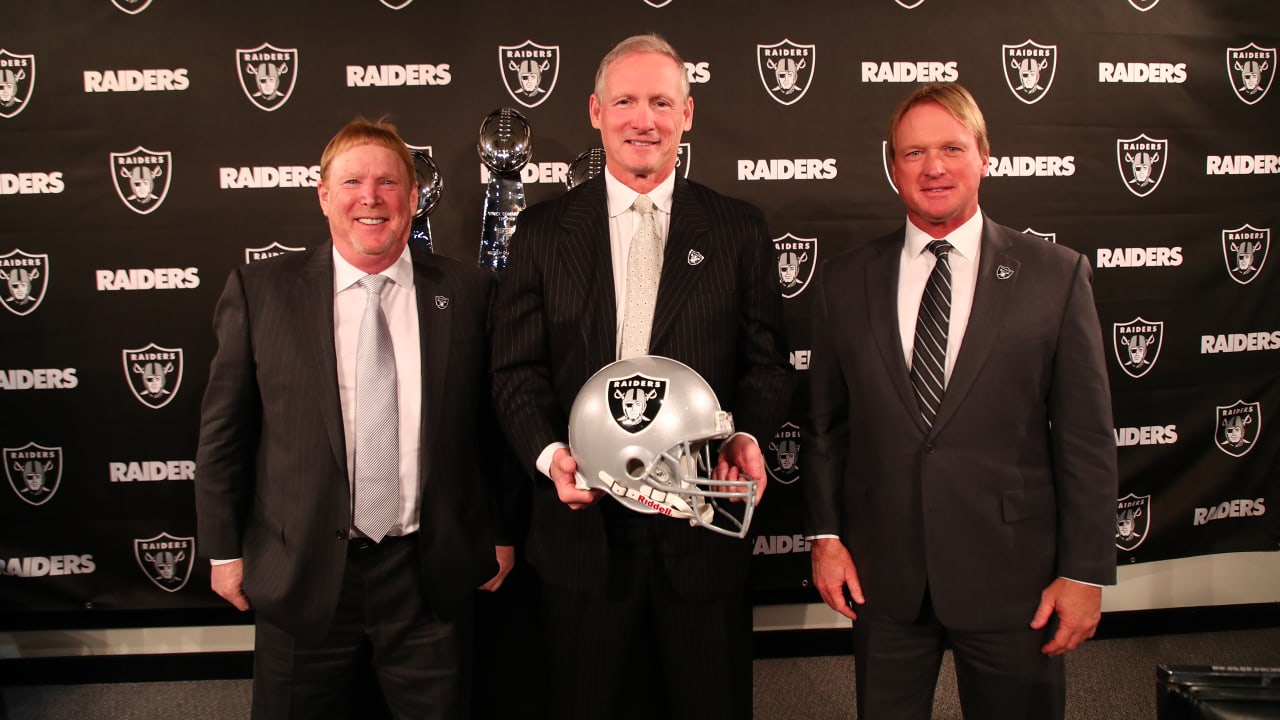
Mike Mayock, Al Davis, and John Gruden Pose for a photo during Mayock’s introductory press conference on December 31st 2018. (Raiders.com)
By Jake Rader
Mike Mayock’s return to the NFL has been unique to say the least. The former New York Giants safety left the game of football at the age of 25 due to a knee injury, and began a career in commercial real estate.
It was during this transition in Mayock’s life when he realized that football needed to be a part of his life. Being a coach’s son, Mayock began studying the game by watching local Pennsylvania high school football games.
Eventually Mayock transitioned into a prominent role with the NFL Network. He became a fixture on television screens every year during coverage of the NFL draft. The media proclaimed the “draft guru’s” knowledge of draft prospects to be desirable information for the average NFL fan for more than a decade.
In 2019, Mayock moved into the next phase of his career, as he stepped into the coveted role of general manager for the Oakland (Now Las Vegas) Raiders.
I recently sat down with the Wayne, Pa. native to discuss his journey back into the league, and his philosophy on how to build a winning team.
How did you end up going to the Haverford School?
My dad was the offensive line coach at the University of Pennsylvania when I was young, and there are seven kids in our family, five of whom being boys. He left the University of Penn to take the head coaching job at the Haverford School. We did not have the money to go there. In fact, we weren’t even close to having the money to afford it with seven kids and one salary. So he took the job at Haverford, where he was a teacher and a coach. All five boys got to go there for free.
So he coached you at the Haverford School?
He did.
What was it like playing for your father at the Haverford School? Was he harder on you as a coach or did he treat you just like one of the guys?
I think initially he was a lot tougher on me. I ended up starting as a freshman. He wanted to make sure that everybody knew there was no favoritism. I probably ran more laps and sprints than anybody in the history of the Haverford School. He kicked my ass up and down the field. I think in all honesty by the time I started playing well during sophomore year, everybody knew I was going to play. Due to this, he started treating me like everybody else.
Transitioning into your years with the Giants. You played under Bill Parcells and Bill Belichick during your time there. How were their coaching styles different and how were they similar?
They were very different, Bill Parcells (later elevated to head coach) when I got there was the defensive coordinator. Bill Belichick was the special teams and linebackers coach. Parcells was born and raised in New Jersey, and was very sarcastic, very tough, and had a good relationship with the players because he was a wise guy. I think one of the best things Bill Parcells did was his ability to motivate star players.
He got Lawrence Taylor to play at a high level every week, and he knew how to get to Lawrence Taylor. He also knew how to get to Phil Simms, which might have been different than Lawrence Taylor. He had a great gut feel for how to get to players and motivate them to play at a high level. Belichick was more of a technician, and knew every position and every player. I mean when he was the coach of the special teams early in my career, he was probably 28 or 29 years old, which is atypical for an NFL assistant coach in that era.
He was so well prepared, and I think that he was probably the best teacher, and that’s what distinguishes him. He was the best teacher I have ever been around in any classroom or any sport. To this day, I tell people that he’s the only coach I’ve ever met in the NFL that could coach every position on his team, and do it better than the position coach.
So back then could you foresee both of them being as successful in coaching as they are today?
Yeah I think I could. Being a coach’s son, I always gravitated towards good teachers. At that
point the Giants teams that I was on were not very good. You could tell that Parcells was kind of turning the roster over, and getting his kind of people in the door. Belichick was going to be special, and unfortunately for me I tore both my knees.
Heading into my third year I was done, and they were about to get really good. You could see it coming and it happened, as a year later they were in the playoffs, and two years later they won the Super Bowl.
How did you end up getting into commercial real estate after you retired? And was it a difficult transition?
Well, I mean I was 25 years old and I was kind of frustrated. I was hoping to have a longer and better NFL career, but the reality of being injured was exactly that. I was married and I had to make money because the money in the NFL in those days was nothing compared to what it is today. I knew I needed to get a job.
I was very thankful that I had gotten an education at both the Haverford School and Boston College. So the fact that I was a college graduate allowed me to compete. I also think that the fact that I was 25 years old allowed me to compete. I interviewed at several different professions because I had no idea what I wanted to do. I wanted to be in the sales marketing side, and I got an opportunity in commercial real estate and got my foot in the door. I had a lot of good years in commercial real estate.
However, I realized very quickly that football had to be a part of my life somehow. So, even though I was working full time in commercial real estate, I was doing high school games on the radio for free for West Chester Henderson and Ridley high schools. I was just trying to keep myself around the game of football because I knew I missed it, and ultimately it had to be a part of what I did.
After your career in real estate you transitioned into a role in sports media, most recently working for the NFL Network covering the NFL draft. Do you have a similar approach in your role as General Manager of the Raiders when it comes to scouting that you did when you were the “draft guru” at NFL Network?
I think evaluating players is similar if you’re going to do it the right way. The difference is that not only is it college players, but also there’s free agency. So I’m sitting here on Sunday in my office in Oakland, and I’m going to be watching a group of college players, and a group of NFL players for free agency.
Also, tomorrow morning John Gruden and I are going to have a meeting with our coaching staff and some of our personal people. During this meeting we’re going to go through our lists at certain positions to get ourselves ready for free agency, and the combine which happens later in February. For 18 years at the NFL Network all I was responsible for was my own individual production for the college draft. I watched hours and hours of tape every day to be prepared. Now it’s a much bigger picture.
It’s not just about evaluating prospects, but also about building a team. That is a totally different conversation, and I find it fascinating because it brings in character. I also find it fascinating because it brings in what kind of people do you want in your building, how you’re doing it, and who do you prioritize. It’s not just about putting a grade on a player, there’s a bigger picture there.
So I loved everything I did with the NFL Network for 18 years, but I’m really happy I’m getting an opportunity to try to compete in the NFL.
When you were doing your mock drafts at the NFL Network, what was your best and worst player projections?
[Laughs] Mock drafts are a funny thing, Jake. I could watch 10 hours of tape a day for nine months and you might just look through some article the day before, and you might just hit as many on the mock draft as I do. So mock drafts are a funny thing, as you try to match a player with a team. For instance, years ago when Aaron Rodgers came out of college he was projected to go in the top five along with Alex Smith. Alex Smith went number one overall, and I had Aaron Rodgers going 24th to Green Bay.
Everybody ridiculed me, and said you have to be kidding me, he’s not going to last all the way to Green Bay. Obviously, that’s where he went to Green Bay in the mid 20’s. My point is that it wasn’t really my reflection of where he should have gone, because, let’s face it, he’s a Hall of Fame player and should have gone higher, and I thought he should have gone higher.
However, I was trying to match him up with where I think he would end up. Aaron Rodgers and I have laughed about it over the years. He was like, “You killed me in the mock draft”. I said, “No I didn’t kill you. I was just trying to put you where I think you’d go”. So that was kind of a good fit for that year, and shoot I’ve missed on tons of guys. It’s honestly hard to figure out one guy because I’ve missed on so many.
I missed on Maurice Jones-Drew, even though that wasn’t a mock draft I had him lower than he should have been. He was a really good football player, and I didn’t give him enough credit for that. That evaluation definitely bothers me. There’s a bunch of them that bother me that I should have done better on.
Transitioning into the Raiders, this year Derek Carr took big strides as his completion percentage, passing yards, and passer rating were the highest of his career. What is your take on his season and his progress as a whole?
I think that he’s in year two of Jon Gruden’s system, and John is really demanding. Jon’s system has a high volume of plays, and demands a lot of mentally acuity from a quarterback. That’s what is great about Derek, as his ability to handle the volume that Jon demands sometimes is mind boggling to me. He really asks a lot of Derek.
So year two I thought that Derek made a distinct jump. He did a great job of handling things at the line of scrimmage, and getting us into and out of plays. Jon gives him a lot of freedom at the line of scrimmage that the average fan can’t understand. He completed 70 percent of his passes for around 4,000 yards. He also doesn’t turn the ball over very much, so I thought year two in a Jon Gruden system he took another step forward.
During the Raiders initial interest in you for general manager, were you surprised that they called you? And when they did was it a no brainer to accept the job?
Well I’ve had some opportunities over the years with other teams. It was never really the right time or right situation during my life. I always knew in the back of my mind that if the right opportunity came, and if my kids were grown that it would be something I’d love to do. When the Raiders called and asked me to interview I said sure.
I flew out here and sat down with Jon and [Raiders Owner] Mark Davis, and we sat at a table for probably four or five hours. It very quickly became just kind of me and John locked in on each other talking football. We focused on talking process about how we both look at building a roster. What was cool is that I knew Jon for years, but this was by far the most intense conversation we ever had.
We really clicked early on in the four or five hours, and it really just became a free for all conversation about how you build a team.
Do you enjoy what you do know more than what you did in the Sports Media Business?
Yeah it’s not even close. I loved what I did at NFL Network as they were awesome to me. I loved every day of it. However, there’s nothing like having skin in the game. I tell people all the time that if you’ve ever played a sport at any level there’s a vested interest in how that team does.
Now at this level it’s very different for me as I could do a game on Thursday Night Football where there’s 20 million people watching the game, and I feel like I did a pretty good job. Then after the game I’ll have a beer and go to sleep. Now Sunday afternoon is an incredibly tortuous three and a half hours, but it’s what it’s all about. That three and a half-hour period is really why I’m back.
Also due to the relationship with the players and the coaches, as all of us are invested in a common goal. You’ll come into our building at 5:30 in the morning every day, and the whole coaching staff is here, the whole personnel staff is here, and we’re working our asses off trying to get better
How critical is it for you guys to acquire a speedy outside receiver to stretch the field and take the pressure off the run game and Darren Waller?
I always tell people when you look at offense in today’s world of spread football and spread offense that I don’t think you need to call people positions that much anymore. However, what you do need are explosive players, you need playmakers. I think we’ve got a playmaker in Josh Jacobs at running back, and we’ve got a playmaker in Darren Waller. Even though Waller is a tight end, he acts like a wide receiver for us because he’s so gifted.
He had 90 catches for over 1,000 yards, Jacobs had over 1,000 yards in his rookie season as a running back. So we feel like we have two explosive playmakers, but what we don’t have is anything else to compliment them, especially with speed. Regardless of what you call the position, yeah we need some outside speed. We need to give Derek some more opportunities to get vertical.
We’ve got a big strong talented offensive line. If we can find the right guy or two that will help us immensely on offense.
Do you think there’s a player like that in this year’s draft?
There’s players like that in every draft, the challenge is picking the right one. If you look at the wide receiver position in the first round over the last ten years, there have been a lot more busts than there have been hits. It’s a little bit of a buyer beware market in the first round for wide outs, so it’s something we are very aware of.
In terms of Darren Waller’s story in his road to redemption, how pleased were you with him this year? As he was taking the right steps forward and developing into a good professional football player?
He’s an amazing young man, and what he’s been through is kind of mind boggling. He was a wide receiver in college, and he’d be the first to tell you that he had problems with recreational drugs and alcohol. He’s had many different instances where he’s been in rehab, and he talks freely about it.
The year before I got here, Gruden and his staff poached him off the Baltimore Ravens Practice squad. They brought him to Oakland, and he played the last four or five games of the 2018 season for us. You could see during this time that he was a freak of nature. He went from being a 225 Lbs. college wide out to a 255 Lbs. NFL tight end. He still runs a 4.5 40-yard dash, he’s got great hands, he’s smart as hell, but he’s had some demons. He freely talks to our staff about it, and he goes to meetings every week. He’s also been sober for over a year and a half. He is very cognizant of trying to help other people who have issues, and he’s one of my most favorite people I’ve ever met.
We signed him to a contract extension during the season this year, and after he signed the contract I asked him what he was thinking. He said, “Mr. Mayock a year ago I sat in this same room when I signed the contract that sent me away from the Ravens. During this time, I just kept telling myself Don’t mess it up because this may be my last opportunity. Now a year and a half later you’re signing me to this big contract and I can’t even believe it”.
So it’s just a wonderful story about a guy who stayed at it who just kept tripping and falling, and was self-aware enough to realize that he needed help. Every day is a battle for him to stay sober, and he just keeps stacking one day on top of another. Now he’s become one of the top players in his position at his profession, it’s just really cool to see.
How would you assess your defense? And how specifically do you plan on filling the holes at linebacker and defensive tackle?
Well we have to get way better on defense everywhere. We’re not very good at all. I think you look at it as a combination of free agency and the draft. I don’t know how it’s going to fall out. We have to prioritize what we need and how to attack it.
Free agency comes first every year obviously, so we’ve got an opportunity and a little bit of money that we can spend. We’ve got an opportunity to try and sign some potential starters. If that’s the case it makes it easier during the draft to pinpoint what direction you want to go. Really it’s just a combination of trying to value the assets you have in both free agency and the draft, and maximize them.
Would you say that you guys consider linebacker a big priority? Because in the last couple years teams have kind of moved away from spending a lot of money in free agency on linebackers, or drafting a linebacker in the first round. What’s your take on that?
I just think that we need good football players on defense right now. We have so many holes, and it’s just a matter of picking the best players. When you’re talking about the draft, if two guys have a similar rating that’s one thing. However, I think when you start reaching for positions in the draft you dilute the overall talent on your roster.
It’s really a good news/bad news situation. The bad news is we’re not very good at certain positions on defense. The good news is we can just go out and find good football players regardless of position.
How’s Johnathan Abram doing? Do you think he’s going to be back this year fully healthy?
Yeah, he’s a difference maker, and he pops off every tape he’s ever played. We took him in the first round last year, and he was outstanding in training camp. In our first game against the Denver Broncos, he came out and was just knocking the hell out of people. He got hurt in the game and tore his shoulder. I don’t know how he finished the game. I knew something was wrong when I saw him miss a couple tackles because he doesn’t miss tackles.
But he tore his shoulder and finished the game. Due to this we had to put him on injured reserve. He’s going to be back at 100 percent, he’s already healthy right now. I talk to him a couple times a week, he’s training in Dallas. He’s one of the smartest, toughest, hardest working young men I’ve ever been around, and I’d be surprised if he didn’t have a big year for us.
Switching gears here, coaches who have had complete control over their teams, such as Bill Belichick, have had tremendous success in the NFL. Bill Belichick, of course, winning six Super Bowls since being granted complete control in 2000. On the contrary, we’ve seen guys like Chip Kelly crash and burn when given complete control. Being the general manager of the Oakland Raiders, a team that obviously doesn’t employ this method, what are your thoughts on this form of team management?
What it really comes down to for me is a system checks and balances. Most teams in a traditional structure with a Head Coach and a General manager have to define up front that there are different responsibilities for each position. The head coach’s primary vision is to win every Sunday, and that’s what they are focused in on. The General Manager’s job is to have a bigger picture of the direction of the organization, and to make decisions for the long-term future of the franchise.
Typically, you’ve got a head coach with a short-term view of winning Sunday, and a general manager with a long-term view. There lies a bunch of checks and balances, and conversations with what’s best for the team, and what’s best for this Sunday. When you have the head coach with full authority and power on everything, it really comes down to just the quality of that one person. This is because there are not as many checks and balances. Bill Belichick may be very special, which he is. I’ve learned more football from him than anybody else I’ve ever been around.
So because he’s so special with leadership, intelligence, he understands all facets of the business. Because of who he is, that system works for them. However, who competes every year and is always good? Take the Ravens and the Steelers for example, those two teams have a more traditional structure. In Pittsburgh, Kevin Colbert has been the General Manager for 15-20 years, and it doesn’t matter if it’s Bill Cowher and Mike Tomlin. The X’s and O’s change with every coach, but Kevin Colbert knows what a Pittsburgh Steeler looks like and smells like.
In Baltimore, Ozzie Newsome has been there for 15-20 years, he just handed over the torch to Eric De Costa who has been with them every step of the way. It’s the same thing there too, it doesn’t matter if it’s Brian Billick or John Harbaugh. The X’s and O’s change, but a Raven still looks like a Raven and smells like a Raven. The checks and balances in those two buildings have been phenomenal, they push each other and they get better every year. That’s the more traditional structure.
What I’ve learned over the last 20 years because my job at the NFL Network was basically to be in all 32 buildings, is that there’s no one right way or one wrong way. It really depends on the quality of the people.
How involved is team owner Mark Davis in the day to day operations with the Raiders?
Mark’s awesome, because he’s at every game obviously. He’s in and out of the building, and splits his time between Oakland and Vegas. He’s on the phone an awful lot with Jon and I. Really what he’s hoping for is a consensus between John and I on direction. If he feels like John and I are on the same page, he thinks it’s the right decision.
If John and I are kind of having conversation, he wants to hear both sides of it and push that conversation forward. He’s really good because he doesn’t get in the way of day to day operations. He’s 100 percent supportive, he’s not a guy who has another industry or a different business. He grew up with the Oakland Raiders and this is who he is. So he’s non-intrusive, yet he’s there when we need him.
How are the facilities looking in Las Vegas?
I think we’re heading into a situation where we’re going to be one of the top teams in the league from a facilities perspective. We’ve got a brand-new stadium. It’s black, it’s sleek, it’s just what you would expect it to look like for the Oakland Raiders. It’s really cool. We’ve got a brand-new facility where we are going to practice about 10 miles away.
It’s state of the art, this area is where most of the players and coaches will live as it is out near the facility. So we’re going to go from one of the older facilities in the league in both stadiums and practice facilities, to one of the newest most state-of-the-art facilities in the NFL. We feel pretty excited about it.
With all that has been going on recently with Antonio Brown, could you see the warning signs from a mental health standpoint? Or are you more shocked with what has transpired?
Well I’m not a mental health expert by any means. I thought we’d get the best out of him coming from Pittsburgh where some things happened at the end of that. We figured that he’d come here with the attitude that he’d want to finish off his career here, and ride off into the hall of fame with maybe a Super Bowl or two.
However, that clearly wasn’t the program. I’m not qualified to talk about what happened in New England, or what happened in his house. Unfortunately, it is what it is, and it’s kind of sad to see.
Are you excited for Vegas? The home field advantage the Knights have had in the NHL has been tremendous. I’m sure you guys are expecting similar support.
I hope we have a good home field advantage. We have to win games first. Vegas is a destination city, so if you’re not a very good football team the fans are going to sell all their tickets to the Eagles when they come play in Vegas and we can’t have that.
Senior Guard Keith Blassingale attempts one of his many free throws during the 2019 season. (cabriniathletics.com)
By Jake Rader
Cabrini University’s men’s basketball season came to a heartbreaking close on Tuesday night, when the Cavaliers lost in the first round of the Atlantic East conference playoffs to Immaculata University, 86-91.
This loss marked the end of an era for the program, as senior captain Keith Blassingale’s career came to a close. Blassingale was very emotional after the final buzzer, as his teammates helped him leave the court.
“Basically it’s one of those dreams that you think is never gonna end, but when it ends you’re like what now?” Blassingale said. “I love this team, I love Cabrini, I love Coach McDonald. It’s why I came back”
Blassingale left it all out on the floor tonight, but his 25-point performance wasn’t enough to propel the Cavs to a victory.
But the senior guard got off to a slower start than usual. Going into halftime, Blassingale had not registered a single field goal. That all changed in the second half, as Blassingale came out firing. The senior single handedly comprised an 8-0 run which led to the Cavs having a 12-point lead with just over 10 minutes to play.
This lead would not last, as Immaculata took advantage of star Cavaliers center Voshon Mack being on the bench due to foul trouble. By the time Mack had entered the game it was too late. Despite eight-points down the stretch from Blassingale, Immaculata was able to hang on for an 91-86 victory. This win means Immaculata will move on to face Wesley College in the conference tournament semi finals.
“Keith has meant a great deal to our program, as he was here a year and a half, and left for a year due to financial reasons to go to Rosemont College,” Cabrini Coach Tim McDonald said. “He came back this year, and was a huge plus for us because he added not only his scoring and ability on the court, but also that senior leadership that we really needed”
“Coming back to Cabrini I was really excited to work with this group, as I made brothers for life,” Blassingale said. “Some of these guys will probably be in my wedding, I’m glad I gained these people in my life.”
During the first quarter, Immaculata held a three-point lead with just under two minutes to play in the first half.
Cavaliers junior guard Dj Smith then proceeded to put on a clinic to close out the first half. Smith ended the half on an 8-0 run all by himself to put the Cavs up four heading into the second half.
During the first 10 minutes of the second half, it appeared that the Cavaliers would carry their momentum from the end of the first half all the way to victory. Cabrini’s two best players, Mack and Blassingale, led by example, as they helped stretch the Cavs lead to as many nine points. But, this elation was short lived, as Mack headed to the bench at the 11:54 mark after picking up his fourth foul.
From then on, it was a downhill spiral for the Cavaliers. Mack was held out of the game for a whopping six minutes. During this time period, Immaculata guard Jordan Ambrose unleashed a barrage of three pointers on the Cavaliers. Despite the heroics from Blassingale, Cabrini was unable to keep up with the high powered Immaculata attack.
McDonald acknowledged after the game that taking out Mack had a negative impact on his offensive game plan. McDonald added that they often look to get Mack the ball inside, and without Mack on the court his source of scoring disappeared for a longer period than expected during the fourth quarter.
Mack was visibly upset on the bench, as he watched his team squander away a 12 point lead, and hence their season as well.
Despite this period on the bench, Mack still managed to finish the game with 25 points, as this stat could have had a different depiction had Mack not gotten into foul trouble.
McDonald recognized that other players were able to step up in his absence from the game, but also said that it is tough to make up for his scoring production.
“I think we have a bright future. Our big freshman Malik Bailey didn’t play this year because of injuries, but he’s gonna be really good. However, we did play and start three freshman this season,” McDonald said. “The future is bright with those guys, and we are a young team and like I said we started clicking later in the year. It would have been nice if we could have got it done earlier in the year, but that is a positive going into next season.”
Blassingale said he plans on playing basketball overseas, as he believes that a 9-5 desk job is something he could never imagine doing.
“I try to treat every game the same, because when you start thinking about it too much that’s when you get in trouble, Blassingale said. “I go into every game with that same mindset, and that’s why I perform the way I perform. It didn’t hit me that my career was over until the final buzzer sounded.”
Lower Merion magisterial district court judge Henry J. Schireson, shown here being congratulated after a victory on election night, announced his intention to seek the Republican nomination for one of two Montgomery County judgeships up for grabs in this year’s elections. ( Carl Hessler Jr/Mainlinemedianews.com)
By Jake Rader
It’s midafternoon, and Judge Henry “Chip” Schireson strolls into his court room for his usual midafternoon hearing. Awaiting him is a woman no more than 21, accused of driving under the influence.
She is extremely nervous, and her parents are in the back of the Montgomery County court room sobbing. Immediately when Judge Schireson starts speaking, the mood of the room changes, as Schireson contains a calming presence that is palpable throughout the room.
“It seems to me that this event took place just shy of your 21st birthday, correct?” Schireson asks the defendant.
“Yes, your honor, replies the defendant.
“Well then I see no reason to keep some of the charges pertaining to underage drinking, and possession of alcohol,” Schireson adds.
The defendant and her family look relieved. “I see no reason to take this case further, and I am recommending the Dui program for you. “As long as you do not get another DUI this incident will go on your record, and you won’t face jail time .”
A big sigh of relief is heard in the back of the courtroom from the defendant’s family, as they are escorted out of the courtroom.
Schireson is no ordinary judge as his career path is interesting to say the least.
As Schireson roams throughout his courthouse, it is apparent just how well liked the judge is. Schireson is truly present for every conversation, as attorneys’ and police officers try to get a word in with the judge.
Schireson continues to walk and talk with people about various situations, and as he offers his advice in most cases. Schireson finally makes it into his office, where he discusses in depth with Robin, his secretary, every case he saw this afternoon.
To Robin, these cases were clear cut, and should require no more than a brief conversation. But Schireson goes in depth, explaining how important his decisions were and how he drew his conclusions for various reasons.
“If you can pick one or two cases that define your career in public service, what would be they be?” Robin asks.
“Oh, that’s easy,” replies Schireson.
Suddenly Schireson gets up out of his chair and shows Robin towards the back of his office. Here there is a court room sketch drawing hanging on the wall that depicts Schireson overseeing a case.
“That is from the Bathtub murder case in 1996,” Schireson says. “It was the most publicized case of my career.”
In addition to this, Schireson pulls out binder’s title “Warlock Case” and “Bathtub Case.” In these folders are newspaper clipping information that relate to the cases themselves, and Schireson’s involvement as both lead prosecutor [Warlock Case] and Judge [Bathtub Case
“These two cases are the defining moments of my career in public service,” Schireson says.
Schireson grew up modestly in Lower Merion, Pennsylvania, nd was a graduate of Lower Merion High School. After a rough start to college at Penn State, Schireson’s GPA sat at 1.2 after his first year.
Miraculously, by the end of his time at Psu, Schireson’s Gpa was a 4.0. After college, Schireson initially aspired to become a journalist. However, he eventually chose to study law at Temple University.
After studying at Temple, Schireson became a prosecutor with the Montgomery County District Attorney’s office. He eventually worked his way up the ladder of eager prosecutors and became head of the sex crimes division.
Schireson says his strategy as a prosecutor was very spur of the moment, as he often would adlib in court, and rarely used a legal pad. Schireson adds that he would often come off as authentic, as his superiors told him his greatest strength was his ability to get a jury to believe him.
It was in 1980 that Schireson made a name for himself, as he was selected to prosecute one of the women from the Warlock Murder case. This was an incident that happened in 1974, as three women, Debbie Detrich, Vickie Schmidt, and Sandra Basile, who belonged to the Warlock biker gang, robbed, and murdered a bar owner and bar maid.
This was a cold case for six years until Detrich came forward and confessed to being apart of it due to a guilty conscience. She struck a plea deal and served eight years in jail and testified against two other women.
Schireson admits that he was selected for the case against Basile because he was probably viewed as expendable. The offices lead trail prosecutor was taken off the case because he failed to convict the mastermind [Schmidt] of murder in the 1st degree.
This was Schireson’s chance to make a name for himself. Prosecuting this case left Schireson incredibly stressed, as the Warlock biker gang was actively trying to kill the star witness [Basile], and anybody involved in the case.
Schireson states that he was not even allowed to go over questions with the star witness [Dietrich] until one night before her testimony. Schireson was escorted there by police, only to find that the Warlocks were following them as they knew they were going to see the star witness.
After an hour-long car chase, Schireson recalls that he and the police lost the Warlocks and were able to see the witness. Eventually, Schireson was able to garner a conviction in the second degree. He adds that this was viewed as satisfactory to his superiors.
Interestingly enough, Basile, [who Schireson convicted] escaped prison and was not found by police until 1990 due to her being on America’s Most Wanted. In his end of year review, Schireson says he was rated by his superiors as the top trial prosecutor.
However, Schireson left life as a prosecutor to enter the private sector as he needed to make more money to support his family. He became a founding partner of Bedford and Schireson law firm in Bala Cynwd and accepted a job on the general counsel of Aramark.
When it was all said and done, Schireson says he only lost one case as a prosecutor, and that he never prosecuted anybody who he did not know was guilty.
Schireson returned to public service as he left Aramark in 1984 to become a District Judge in Montgomery County. After serving for 12 years, Schiresson was thrust into the public spotlight as he was overseeing the first hearing of The Bathtub murder case.
This case involved a Lower Merion man named Craig Rabinowitz, who claimed to have found his wife lying dead in the Bathtub. However, the police believed that he murdered her due to there being no signs of a possible break in, as only he was in the house when she died.
Schrieson said that he had never seen so many people in his court room, as the media ranged from your local news to People Magazine. After days of hearing arguments, Schireson concluded that the police were right, and pushed the case forward to the higher courts.
In the year 1999, Schireson was selected to a panel of people that planned to reform Pennsylvania court system. This was called the Pennsylvania Judiciary Supreme Court. Schireson was selected to represent his judiciary level which contains 540 judges across the state of Pennsylvania.
Schireson calls this the highest honor that he has received in his career on the bench. However, in 2003, Schireson faced a tough reelection campaign against Donna Haas, as she had the endorsement of then Governor Ed Rendell.
She claimed that Schireson was a part time judge and cared more about the Supreme Court more than the people of Montgomery County. Schireson, who believes wholeheartedly that politics should be kept out of the court room, ran a positive campaign, and let his experience and ethics do the talking.
In the end, Schireson came away with the victory, and still serves on the bench the bench in Montgomery County to this day.
As Schireson closes his scrapbook, a smile creeps unto his face. “This is my life in pictures, Robin,” Schireson says. “I’m so glad I kept these books; I remember so many things in my life just from looking at them .”
While Schireson and Robin walk to their cars after a long day at the courthouse, Robin ponders a question.
“So, what’s next for you, Chip?” she says.
“Hopefully, I’ll be above ground for a little while longer,” he joked. “In all seriousness, I’m looking forward to spending time with my grandchilderen, and travelling with my family .”
Summary: On August 27th, 2018, two days after the death of Senator John McCain, PBS released a documentary chronicling the storied career of the Congressman. After serving his country with honor during his harrowing time as a prisoner of war (POW) during the Vietnam War, McCain transitioned into politics. McCain entered Congress in 1987, during a period in which Democrats and Republicans often worked together as colleagues. Over time, the parties grew farther and farther apart, McCain having a front row seat. However, McCain did not succumb to the changing ideology of the Republican Party. He stuck to his principle of being a moderate Republican and earned the reputation for being a “maverick” due to his ability to see past party lines pertaining to many issues. McCain was known for criticizing members of the Republican party who possessed far right ideals. This would hurt McCain as in 2000 he lost the Republican nomination to George W Bush. Bush had the backing of the Republican establishment, which played a large part in McCain’s downfall. In 2008, McCain rebounded and won the Republican nomination. However, in order to appeal to the right-wing base, McCain nominated Sarah Palin as his running mate. This decision is largely viewed as why McCain lost the election, and this choice haunts McCain, and a large segment of the population to this day.
Talking Points:
McCain shows up to congress to vote against President Trump’s Affordable Care Act Reform just one week after being diagnosed with brain cancer. ( 1:03-7:39)
McCain was captured during the Vietnam War, and held by the Vietnamize as a prisoner of war. (12:00-16:04)
McCain begins to show an interest in Politics. (16:40-19:39)
McCain and four other Democrats are subject to an inquiry that revolves around their dealings with an Arizona savings and loan owner Charles Keating. (20:35-22:52)
McCain finds himself in a changing Republican party after the 1994 midterm elections. (22:43-25:03)
McCain ran a failed presidential campaign in 2000. He lost the Republican nomination to eventual president George W. Bush. (25:35-30:10)
After years of being an outsider in the Republican party, McCain makes peace with right-wing leaders in order to gain support for his 2008 presidential campaign. (30:11-34:35)
Due to lacking support from the Republican base, McCain nominates Sarah Palin as his running mate. (34:41-45:36)
Sarah Palin endorses Donald Trump’s presidential campaign in 2016. (45:38-52:22)
Significant Sources (In no particular order):
Peter Baker, The New York Times
Senator Susan Collins (R-ME), McCain’s close friend.
Orson Swindle, POW from 1966-1973, McCain advisor and friend.
Veronica Clarke, McCain Press Secretary from 1983-1989
Senator Gary Hart (D-CO) 1975-1987, McCain’s close friend.
Senator William “Billy” Cohen (R-ME), McCain’s close friend.
Rep. Newt Gingrich (R-GA), House Speaker from 1995-1999.
Senator Lindsey Graham (R-SC).
Matt Bai, The New York Times Magazine.
Tom Daschle, (D-SD), Majority Leader from 2001-2003.
Important Clips:
12:04-13:51
17:28-18:02
21:41-22:54
41:27-42:28
47:04-48:37
Conclusion:
When John McCain died in 2018, he left behind a legacy that will be remembered by Republicans and Democrats alike for generations to come. McCain always did what he believed was right, no matter the cost. He acted in a way to represent what he believed was in the best interest of the country, and Republican hearsay did not matter to him. McCain would rather commit suicide than dishonor his country. He truly put his country first. Nevertheless, the irony in McCain’s story is palpable to say the least. McCain realized that after the Republican establishment sabotaged his campaign in 2000, he would need the far right in order to have a chance at winning the election. McCain bargained with people he spent the majority of his career opposing and nominated Sarah Palin in order to appeal to the base. Sarah Palin energized this segment of the Republican party like nobody had ever seen. However, that was until Donald Trump won the presidency in 2016. In a way, Palin was a microcosm of what Donald Trump would become, as the Tea Party movement is the basis for the modern-day Trump supporter. It’s quite ironic to think that John McCain, who spent a large part of his career opposing this segment of the party, would inadvertently be responsible for the divided congress/nation we have today. It is a tragic end for an American hero, and without a doubt one of the most honorable, and decent individuals our country has ever seen: John McCain.
“Kill Bill Vol 1” is Quentin Tarrantino’s effortless dive into the Kung Fu movie genre. Tarrantino tells the tell of The Bride (Uma Thurman). The Bride embarks on a blood thirsty killing spree centered around revenge against the Deadly Viper Assassination squad.
The Bride chooses to leave the Deadly Vipers and start a new life in El Paso Texas as she is pregnant and does not want to live the life of a bounty hunter. This angers Bill (David Carradine) who is the leader of the Squad, and the father of The Bride’s baby.
Bill orders his associates Venita Green (Vivicia A Fox) O-ren Ishii (Lucy Liu), Elle Driver (Darryl Hannah), and Bud (Michael Madsen) to kill The Bride, and everyone at her wedding rehearsal. The bride miraculously survives and wakes up from a coma to begin her revenge tour.
Tarrantino puts on a masterclass in this film by telling the audience a whole lot, while having the characters say so little. A prime example of this would be whenever something ticks in The Bride’s head that causes her anger.
When this happens, the camera zooms in directly on her face, and chaotic music plays. A lot of these moments tend to have flashbacks associated with the them from events caused by trauma. The serious ness of the expressions on people’s faces do all the talking in this movie of little dialogue.
Take the look on The Bride’s face after she kills Venita Green. Green’s child (Amberosa Kelly) is standing in the room, overlooking her dead mother.
The Bride glances at the child with a slight look of compassion, but still a relatively cold look and says, “If you still feel raw about it, I’ll be waiting.”
This was a brilliant idea by Tarrantino, as the scene leaves the door open for a third film that would follow this plotline. It would be an unbelievable third installment to the legendary franchise to have Venita’s daughter attempt to hunt down and kill the Bride.
Another sign of compassion is shown in how The Bride and Venita Green react when Venita’s daughter walks through the front door. They go from a grewsome knife fight, to stopping dead in their tracks, so Venita’s daughter does not see their actions.
What I took away from this is that these women want more for their kids than the life of killing they lived. Similar to how The Bride ran away to El Paso in order to start a new life with her child, Venetia has moved to California in order to giver her child a better life.
What also amazed me in this scene was how quickly the tone changed. These two women went from having a deadly knife fight, to having a cup of coffee and casually talking about how they wanted to murder each other.
The music in this Tarrantino masterpiece plays a large role in this movie’s greatness. This movie has the feel of 1970’s kung fu movie. The music sets the tone giving it a very intense mood. Nothing describes this better than The Bride’s final showdown with O-ren Ishii.
The intense stare down and minor trash talk is right out of a Bruce Lee film. In addition to this, every movement the two foes make line up ever so gracefully with the somewhat triumphant tune of the Santa Esmeralda track “Don’t Be Misunderstood.”
When Ishii puts her fingertips on her sword, and draws her weapon I got chills down my spine for a solid two minutes. This somewhat uplifting song could seem oddly placed for a such a serious and deathly scene.
This song choice symbolizes that one of them will come out of this battle victorious. The song coupled with their facial expressions is essentially saying “Give me your best shot.”
Tarrantino had other instances in which he used symbolism brilliantly in the second act. Two prime examples of that are in The Bride’s scenes with weapon maker/samurai Hatori Hanzo (Sonny Chiba), with the first being when The Bride first lays eyes on Hatori’s swords.
As she picks up the sword, a love song begins to play as she swings the sword from side to side. Her face is in a trance while glancing at the sheer beauty of the sword.
This love she shares for the sword is symbolic as this weapon of violence is truly the only thing The Bride loves in the world, as everything else has been taken away from her.
Shortly after this exchange, Hanzo writes Bill’s name on the one of his glass windows, as he leaves the room after agreeing to train The Bride. Once Hanzo leaves the room, The Bride erases Bill’s name from the window. This depicts how she wants to erase Bill from the world.
Prior to The Bride’s dramatic victory over O-ren Ishii, she must face all O-ren’s men first as O-ren is now the Head of the Yakuza Gang in Toyoko. The members of her gang “The Crazy 88” are simply no match for The Bride.
She tears through them somewhat effortlessly, before she makes her way to O-ren. This battle sequence is done masterfully by Tarrantino, as the choreography is amazing. The Bride slices people limb by limb as it is extremely gory.
If you can past the blood and guts, the amount of sheer time and effort that was put into making scene is something to marvel at.
Prior to the gruesome fight scene, I noticed a subtle piece of irony that is snuck into the movie masterfully. One of O-ren’s associates, Sophie Fatale (Julia Dreyfus) is in the bathroom when she gets a phone call.
Oddly enough, the ringtone on her phone is “Should Old Acquaintance Be Forgot.” The Bride is in the bathroom and hears this.
This is ironic because Sophie would probably like to forget her acquaintance with The Bride and move on from it. Prior to this moment she probably thought she had moved on. However, this is far from the case as Sophie’s old acquaintance cuts off her arm in the next scene.
Overall, “Kill Bill Vol 1” is a great first installment to the Kill Bill Franchise. Kill Bill Volume 1 contains more actions sequences compared to “Kill Bill Vol 2.” “Kill Bill Vol 2” is a great watch if you are looking to learn more about the backstory of The Bride and Bill. This film was a pleasant surprise, and I would give it 4 out of 5 stars.







 Jake's Takes