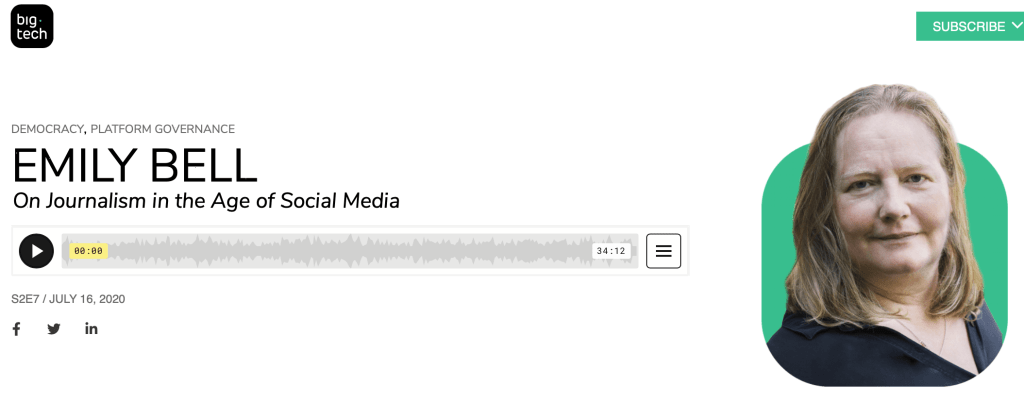
By Jake Rader
When listening to Emily Bell on the “Big Tech” Podcast, it required me to take a step back, and look at the role journalism has in today’s society. Journalism is extremely important to society for multiple reasons. For starters, journalism keeps our politicians in check, and holds them accountable. Without honest, and unbiased Journalism, the people in charge of running our great nation could potentially abuse our countries democratic values. Journalism also functions as a way to inform the public of the problems the world faces, and how we can fix them. It informs the people on many facets of daily life, whether it’s sports, politics, finance, or even pop culture, journalism is designed to function as the main way we as a nation stay informed.
However, to the detriment of our society, the internet has changed the journalism industry for the worse. When the Internet was invented in the early 1990’s, many had believed this would be a positive thing for the news industry. On paper, it’s honestly hard to argue with that assertion. For starters, the internet functions as a way to reach a large audience, so this was viewed as a win-win situation for the industry. All they had to do was put their daily paper on a website, and just like that they could reach citizens all over the world who would not normally have access to their publication. Except, it was not that simple.
First off, the way the newspapers presented their content was not user friendly in the slightest bit. A version of the New York Times for example would literally just be a copy and paste of the newspaper, the same as the one delivered to people’s doorsteps. It is night and day looking back on how Newspapers presented their content in 1993, to how they do now.
To make matters worse, large search engines like Google proceeded to undercut the main source of revenue these Newspapers relied on in advertising dollars. Advertising in Newspapers was, and still is crucial to the success of these organizations. Once the internet, and Google came into the fray, they were able to offer advertisers things that the papers could not. Not only would Google offer these companies cheaper prices to advertise with them, they would also provide these companies with a larger reach to gain traction for their products. This undercut the news Organizations, and as Emily King mentioned, this was the main way that big tech subsidized journalism.
Aside from the financial problems that came with the internet, that was the least of the problems for the industry. The internet essentially gives everyone a platform to say basically anything they want, with largely very few reprecttuions. In theory, anybody could start their own blog, and reach a large audience. This type of access to content that was not at times credible was detrimental to the new media’s own credibility. This led to the rise in fake news, and people not knowing what source of news is reliable/unbiased. The internet is the meeting ground for mis information, and conspiracy theories, as the news media does not have the grip on the american public like they once did.
To be honest, it will be hard for the media to function for the public good like they once did. The mainstream media has already been beat to the punch, as there are alternative sources of media that have been more accessible/more user friendly outlets that dominant today’s media landscape. Take platforms like Brietbart, and Vox, these are platforms that aren’t even close to as reliable/trustworthy as say the Washington Post, or the Philadelphia Inquirer. But yet, they are biased blogs that take away readers from respectable news outlets. Which is why in order for news media to function as a public good, we need big organizations, and companies to pour money into historically respectable, and unbiased newspapers. We need money to be put into these news outlets to combat the spread of fake news, and drown the conspiracy theorists out.
Granted, this proposal is a lot easier said than done, but it may be our only chance for journalistic integrity to survive.

 Jake's Takes